

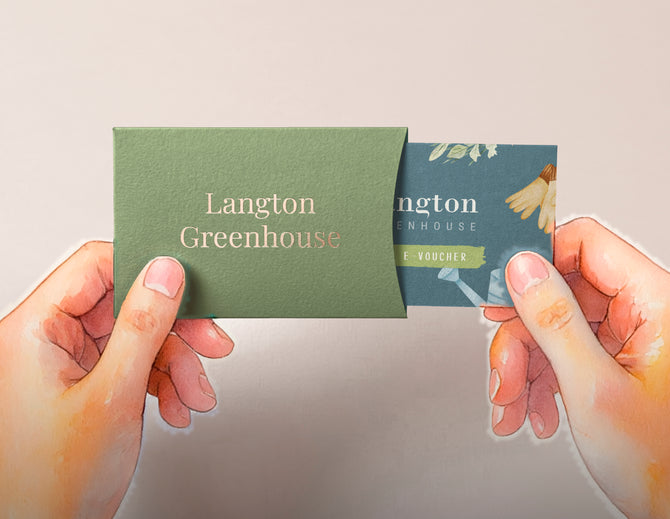


Grow with Langton Greenhouse
Our Garden Centre
The Garden Centre department is at the heart of Langton Greenhouse. We are proud to have stayed true to our roots as we have grown and to remain a place defined by care passion and expertise offering a wide range of plants flowers and garden supplies for every season.

What do we offer at our Garden Centre?
Our garden centre offers a wide range of everything you need to create, grow and enjoy your outdoor space. From quality plants and gardening essentials to tools, compost, and feeds, we’ve got practical solutions for every job. You’ll also find decorative features, outdoor furniture, and seasonal inspiration to help bring your garden to life, all supported by our knowledgeable team, always ready to help.

Compost & Aggregates
Our wide range of compost is 100% peat free, helping you garden more sustainably. We also offer convenient local delivery on all compost and aggregates, with free delivery on orders over £200.

Plants & Seeds
We offer one of the finest selections of indoor and outdoor plants in the area, including a range of unusual and hard-to-find varieties. Every plant is expertly cared for by our knowledgeable and dedicated team.

Gardenwear
From great value gloves in multipacks to hand-stitched leather designs, and the comfiest selection of garden clogs, this range has everything you need to stay comfortable and protected outdoors.

Tools
Whatever the task, we've got the right tool for the job. Shop quality forks, spades, secateurs, hoses and more from trusted brands including Wilkinson Sword and Kent & Stowe.

Feeds & Treatments
Looking to boost your tomato harvest, or tackle some troublesome pests? Our Feeds & Treatments range has everything you need to help your garden thrive.

Plant Pots
We have an amazing selection of pots for indoor and outdoor, at great prices! From popular brands such as Woodlodge, Sass & Belle and Ivyline.

Garden Furniture & Accessories
From elegant bistro sets to stylish garden statues and decorative mirrors, discover everything you need to add the perfect finishing touch to your garden.

Wildlife & Pet Care
Everything you need to support your garden wildlife and household pets, from quality feeds, homes and habitats to everyday essentials.
In-Store & Online
Discover our Compost & Aggregates
Our compost and aggregates are available in-store or online for local delivery & collection.
Our compost and aggregates are available in-store or online for local delivery & collection.

Compost
Shop our best selling range of compost, including John Innes, ericaceous, aquatic and much more! We have bundle discounts to help you save money and all items you see online are in-stock and ready to be delivered locally!

Aggregates
We sell a range of aggregates including various barks, chippings, cobbles, slate, gravel and pebbles. We have bundle discounts to help you save money and all items you see online are in-stock and ready to be delivered locally!
In-Store Only
Explore our Plant Selection
Here you’ll find an overview of the plants we offer throughout the year at our garden centre. While we don’t sell online yet, this section will give you a good idea of what’s available in-store.
Here you’ll find an overview of the plants we offer throughout the year at our garden centre. While we don’t sell online yet, this section will give you a good idea of what’s available in-store.

Perennials

Fruit & Ornamental Trees

Herbs

Alpines

Climbers

Houseplants

Seasonal Bedding

Vegetable Plants

Fruit Plants

Shrubs

Ferns

Roses
Because of the delicate nature and careful handling required, we’re only able to sell plants in-store and offer local delivery to ensure they arrive in the best possible condition.

Meet the team
We take great pride in our Garden Centre’s journey from its beginnings to where it stands today, made possible by our passionate and skilled team.
Learn about our manager Cory’s journey and how he helped shape our Garden Centre into what it is today.
Garden centre
FAQs
We can answer nearly any question you have about plants and caring for your garden. Our knowledgeable and friendly team is here to guide and support you every step of the way. From compost and plants to bedding, pots, seeds, and aggregates, we provide everything you need to bring your garden to life.
What can I grow in shade?
Shady areas in the garden are often seen as problematic, but this is far from the truth, and there are a huge range of plants well-adapted to growing in shade. One thing to decide first is what kind of shade you have, is the soil damp? Is it very dry, under large trees for example? Is it ‘light’, dappled or partial shade that receives some sun, but only for a few hours? Or is it deep shade that receives no direct sunlight at all? Knowing this can help with your plant choices. A few examples:-
Partial to full shade with decent moisture:- Ferns, Foxgloves, Hostas, Astrantia, Polemonium, Brunnera, Dicentra, Epimedium, Hakonechloa (Japanese forest grass) and lots of Hardy Geraniums would thrive here.
Deep, dry shade under trees:- Vinca, Ajuga, some ferns such as Polypodium, Bergenia and Aucuba will tolerate these difficult conditions.
Damp shade with soil that doesn’t dry out in Summer:- Ligularia, Astilbe, Hostas, Matteucia (shuttlecock fern), Osmunda (royal fern), Rodgersia, Candelabra Primula, perennial Lobelia will all thrive in soil which stays moist in Summer.
There are also several shrubs which will tolerate shady spots if you need something bigger, but again, it’s important to know which kind of soil you have first. For instance, Hydrangeas are great for shade but need soil which stays moist in Summer, whereas the Spotted laurel, Aucuba japonica, can tolerate dry shade under trees.
Consider lots of bulbs too. Many bulbs are woodland plants, emerging early in the year before the tree canopy becomes too shady to survive. Snowdrops, Bluebells, Wood Anemones and Crocus will all give a fantastic early show in a woodland setting before the shade sets in, when the perennials can then take over.
Can I grow a tree in a pot?
In short, yes, any plant, including many trees, can technically be grown in a container, but it’s important to choose the right tree dependant on how much space you have and how big a pot your garden can take. Larger trees such as Liquidambar, Eucalyptus and Betula (Silver birch) for example would need very large pots to keep them happy for the long term. We’ve listed below a selection which are much better suited to container growing:-
Amelanchier (all varieties), Acer (Japanese varieties), Cercis, Prunus (flowering cherry, avoid varieties such as ‘Taihaku’ and ‘Kanzan’ as these are too big), Malus (Flowering crab apple) Sorbus, Olive.
For all trees in pots, its important to remember to water regularly and feed well through the growing season to keep the trees happy. If a tree is too big for your space, larger shrubs such as Photinia ‘Red robin’, Camellias, Rhododendron, Viburnum etc also make great container specimens.
How and when do I prune my Hydrangea?
It’s important to know which group your Hydrangea is in before doing any pruning. Below we’ve split it into simple groups to help you prune yours correctly:-
Lacecap/Mophead types:- The most commonly planted, ‘traditonal’ type with large flowers in Summer. These varieties produce their flowers on the previous years growth. Leave the old flowers on the plant over Winter, this helps protect the developing buds from frost. Then, in March, cut back the stems by approximately a third, to a pair of strong buds, which will then produce the flowers for that year. On older plants, some very old stems can be removed completely, roughly a third again, to the ground, to encourage fresh new stems from ground level. Do this harder pruning though across a few years, so as not to remove all flowering stems at once.
Paniculata types:- This group has become very popular in recent years, and is easily recognised by its very large, pointed ‘panicles’ of flowers in late Summer and Autumn. These flowers are produced on current seasons growth, so pruning for this group is very simple. Again, as before, it’s best to leave the old flowering stems on the plant over Winter, then in March, cut all stems back hard to approximately 30cm from ground level, to strong buds. Pruning this way produces vigorous stems and huge flowers in Summer. Lighter pruning will lead to more flowers per plant, but they will be smaller.
Giant ‘Annabelle’ types:- This groups is easily distinguishable by its truly huge flowers, the size of footballs! ‘Annabelle’ is the most well known variety, with its huge white flowerheads. Like the Paniculata group, these produce their flowers on current seasons growth, so pruning is the same, cut the stems back to strong buds in Spring, roughly 30cm from the ground. This will lead to truly enormous flowers on strong stems in Summer. Lighter pruning again will lead to more flowers, but they will be smaller.
When pruning all varieties, it’s a great idea to mulch them well and top dress with a feed to encourage the new growth, Bonemeal or Fish blood and bone is perfect.
I bought a blue Hydrangea, but this year the flowers have turned pink, why is this?
A common problem, with many people buying the beautiful, China-blue Hydrangeas in flower, only for them to flower pink, mauve or a mixture of both the following year. This is due to soil PH. Blue flowered Hydrangeas need acidic soil to stay that lovely blue colour, so it’s worth testing your soil first with a PH testing kit, and if you have acid soil, great, your blue Hydrangea will stay blue, if your soil is neutral or alkaline, you can still plant them, but make sure you add Ericaceous (acid) compost at planting time, and feed regularly during the growing season with Ericaceous feed to ensure the flowers stay blue.
How do I prune my Wisteria to encourage flowering?
A common issue with Wisteria is that, once planted, they just love to grow, producing masses of stems and green, leafy growth but not much flower. There are several ways of encouraging flowers, including pruning techniques, as follows:-
Firstly, its important to ALWAYS buy grafted Wisteria, NOT seed raised. Seed raised plants can take up to 25 years to flower, and even then, it’s not guaranteed. Grafted plants will flower usually within 5 years of planting, some even sooner.
ALWAYS plant your Wisteria in full sun, whilst they will grow in shade, it severely limits their flowering capability.
Once you’ve selected your position, and planted your Wisteria, one trick to encourage flowers sooner is to train as many stems horizontally as possible. This slows down the transmission of water and nutrients through the stems, which itself encourages flower buds to form.
Now for the pruning. This can sometimes sound tricky, but really isn’t! We recommend spending around 3 years initially training your Wisteria before doing any pruning, this can help establish a strong framework of branches to work with. Then, once established, it’s a simple case of remembering two dates, The longest day of the year, and the shortest day.
By the time we reach the longest day of the year, your Wisteria will have produced lots of long, ‘whippy’ shoots over the whole plant. On or around this date, simply prune all of these long shoots back by half. Then, on or around the shortest day of the year, when the plant is dormant, cut the remaining ‘half’ of this growth back to 2 to 3 buds. This will leave you with lots of short ‘spurs’ all over the main branches. This pruning method encourages those spurs to become flower buds. Usually, within a couple of seasons of pruning established plants this way, your Wisteria will be dripping with flowers!
Which Houseplants are good for bathrooms?
Bathrooms are often warmer, damper and sometimes darker than other rooms in the house. Choosing plants which will tolerate these conditions, even thrive in them, is essential. A few examples:-
Boston fern, Epipremnum (Devils ivy), English Ivy, Asparagus fern, Spider plant, Peace lily.
Avoid Cacti and succulents as they won’t tolerate the extra moisture. Also, you may see online some plants recommended for rooms with no windows, DON’T BE FOOLED!! If there is no natural light at all, there are no plants which will grow here! All plants, even those which will grow in deep shade, need some natural light to photosynthesize.
Which houseplants are good for hot, sunny rooms and conservatories?
Similar to the previous question, this is another case of ‘right plant, right place’. Hot, sunny windowsills and hot, south facing conservatories can be too extreme for many plants, so always avoid large, ‘leafy’ plants such as Monstera (cheeseplant) as their large leaves can easily burn. Cacti and succulents are a great choice, and plants such as Yucca, Agave, and some palms, such as the Phoenix palm will tolerate the intense light and heat.
What can I plant instead of Box for a short hedge or for topiary?
Sadly, Box blight and the Box caterpillar have now become such a big problem, with no treatments available for either issue, that it really isn’t viable to plant Box now as either a hedge or for making topiary shapes. Listed below are our suggestions for the best alternatives:-
Ilex crenata ‘Jenny’:- The best, most reliable form of Japanese holly, it looks almost exactly the same as Box, has a similar growth rate and habit, and is less fussy about soil type. Other forms are available, but we think ‘Jenny’ is the best on the market.
Euonymus ‘Jean hughes’:- An all-green form of Euonymus with small leaves, and a fairly vigorous growth rate. Tolerant of most soil types, and happy to grow in shade. Euonymus ‘Green spire’ is another good form, but has a narrower habit, so is better for low hedges. There are also many variegated forms available, all of which are easy to grow and take kindly to being clipped.
Lonicera nitida:- Used for many years as a hedging plant, this evergreen has tiny leaves and a fast growth rate, and takes well to clipping. Like the Euonymus, also good for shady spots. Needs regular trimming to keep it neat. There are lots of forms available with different leaf colours, including purple and gold forms.
Pittosporum tenuifolium:- A lovely evergreen from New Zealand, but totally hardy in the UK if planted in a sunny spot with good drainage. There are many forms available in many leaf colours and forms. The dwarf purple form ‘Tom thumb’ is great for low hedging and topiary, going a deep, rich purple in Winter. The variety ‘Irene Paterson’ has striking, pure white new growth which becomes speckled with green as it ages. If you prefer gold foliage, choose ‘Gold star’ or ‘Warnham gold’. Another bonus is the honey-scented flowers, produced in Summer. All varieties are happy to be clipped into shapes and for hedging
Why hasn’t my Camellia had any flowers this year?
The Camellia is one of the most beautiful of all flowering plants hardy enough to grow in the UK, but does need quite specific conditions in which to thrive, and if it doesn’t have these, it will often not produce flowers and can look ‘sickly’ and yellow. Below we list the ‘essentials’ for Camellia success:-
Partial to full shade is best, with shelter from early morning sun and strong winds. A spot in shade, near a west facing wall or fence is perfect.
Acidic (ericaceous) soil is essential, and in order to set lots of flower buds, they need plenty of moisture during Summer. They will not tolerate hot, dry soils. Water plants well in dry spells.
Feed well during Summer with Ericaceous feed. If your soil isn’t naturally acidic, the acidity in the Ericaceous compost and feed is quickly washed away, so regular feeding in Summer with a liquid Ericaceous feed can ensure deep green leaves and lots of flowers. In Autumn, provide plants with a deep mulch of either composted bark or Ericaceous compost to help retain moisture, protect roots from excess cold and to help maintain the soil PH.
For growing Camellia in pots, all the rules still apply, place the pot in a shady spot, away from early morning sun, use good quality Ericaceous compost, keep the plants well-watered, especially in Summer, and feed well with Ericaceous feed once established.
Which trees can I plant to screen a nearby house that overlooks our garden?
This is becoming a very common question, with many modern houses having small gardens overlooked by neighbours. There are many ways to screen a nearby window, either with tall evergreen trees and large shrubs, or with trellis and fencing covered with vigorous, evergreen climbers. Some popular options include:-
Eucalyptus gunnii:- The hardiest Eucalyptus to grow in the UK, with striking blue foliage, and attractive peeling bark on older specimens, but comes with a warning, it is very fast growing, and ultimately very large, so its worth pruning the crown every few years to keep it from getting too tall. Not really suitable for small gardens.
Cotoneaster ‘Cornubia’:- An evergreen tree with the added bonus of bright red berries in Autumn which are great for birds. Fast growing but never too large, and takes kindly to regular pruning if necessary. Very hardy and easy to grow.
Arbutus unedo ‘Marina’:- A gorgeous evergreen tree with glossy foliage and pretty flowers in Spring, which are followed by large, strawberry-like fruits. These fruits are edible, but don’t taste very nice (the ‘unedo’ in its name is Latin for ‘I eat one’!) Older specimens develop a beautiful, peeling, deep cinnamon-red trunk. A tree we feel should be more widely planted.
Eleaegnus ebbingei:- A large growing evergreen shrub, with attractive silvered foliage, and very fragrant flowers in late Summer and Autumn. Fast growing and very hardy, growing equally well in sun or shade.
Photinia ‘Red robin’:- Large evergreen shrub with striking red young growth in Spring. Fast growing and hardy, and tolerant of a wide range of soils and positions. Takes kindly to pruning, so can even be grown as hedge.
Prunus laurocerasus:- The well known ‘Cherry laurel’, an easy to grow evergreen with large glossy foliage. Very easy to grow, quickly reaching a good height, making it perfect for screening and hedging.
For fences and trellis work:- Trachelospermum jasminoides, the ‘Star jasmine’, has become the most popular climber for screening. Evergreen leaves on vigorous stems become covered in highly fragrant white flowers in Summer. Prefers a sunny spot but is otherwise not fussy. Lonicera delavayi is an evergreen form of Honeysuckle, with highly fragrant Summer flowers, another climber which grows quickly and can provide good screening. There are also evergreen forms of Clematis, however, these need more care in terms of where they like to grow. If you can provide a sunny position with protection from cold winds and the worst frosts, they can also provide good cover.


Other Pages


